
Justin Chastel, Founder or Failure?
Jim Engel Copyright 1995
Author's note: Justin
Chastel, father of the modern
Bouvier des Flandres, passed away in September of
1995. These were my comments at the time...
__________________________________________________
It was the tenacity of the man. For me Justin Chastel was always the mysterious, ever present figure on the horizon, intertwined in the history and future of the breed. I have been held in the grip of fascination with men such as this - Chastel, Verbanck and Moreaux - whose roots go to the very beginning. Chastel, the sole European founder to live into my era, was always an enigma, an enigma which became deeper and more imponderable as the years passed. Beginning in the 1930s, poring over the Belgian breeding books, I could see his influence at every turn. You can see it in old black and white photos of Soprano de la Thudinie, whelped in 1944; the lean, square, athletic dogs with the bold expression and confident stance. Through sixty long years he held in his mind's eye a vision of the breed which he relentlessly sought to render into flesh and blood.
The man was capable of the unpopular, inexplicable action; for after more than half a century, and two decades as president, he abruptly resigned from the Belgian Bouvier club. This is the mystery of the man, for anyone else such an action at such a late date would have been beyond comprehension.
Now he is dead. In seeking closure to this
episode of Bouvier history many memories, events and dogs whirl through my
mind. I admit to a certain emotion at the loss of this great man who I knew
only in a limited way on a personal level, yet know intimately through his
life's work and his conflicts and his struggles, some of which we shared. For
me, the attempt to finally solve the riddle leads back to the simple statement.
It was the tenacity of the man.
For the better part of a century Chastel was
a driving force. His father and his uncle trained and bred dogs for the Belgian
Ring. When he was born about 1910 the formal organization of the breed lay in
the future; and when Europe emerged from the First World War he was still at
the beginning of his life. When he began his own breeding in the thirties the
Bouvier was just emerging as a factor in Belgium and the originators were still
on the scene.
This man endured. As a child he and his
family survived at the epicenter of the most cruel and painful war in human
history. Just as he began to achieve success as a breeder, the Germans yet
again overran his homeland in their lust for power and their relentless desire
to possess the land and resources of their neighbors. In the less sophisticated
days of veterinary medicine, disease could sweep through a kennel, wiping out
years of work and effort. In the early fifties the breed nearly flickered out,
with fewer than a hundred per year being registered in Belgium for five long
years.
Chastel was a driven man, obsessed with his
vision of the breed, compelled by an iron will. Unfortunately this led to
conflicts with others, often old and devoted friends, who shared his passion
but saw different means to the common end. Through the years many old friends
became estranged; certainly a most melancholy aspect of his life. Perhaps it is
best to simply accept the man for what he was, for if he could have been made
more diplomatic and flexible would he have still had the iron will? Would a
lesser man have compromised, been reasonable, participated in the debasement of
the breed we see before us today? Could the hard edges have been removed
without taking the temper out of the steel?
Because of my fascination with the evolution
of the breed, Chastel was most frustrating for me personally. Even though I
visited his home on numerous occasions and met him at many canine events, it
was almost impossible to get him to answer questions, to speak of the past. The
language was of course an impediment, but the real problem was his
preoccupation with today's issues of politics and breeding.
In the fall of 1993, I yet again made the
pilgrimage to Thuin, crossed the river Sambre and spent an early afternoon in
conversation with Mr. Chastel. You knew the man was old, could see it in his
face and hear it in his voice. My purpose was of course to pay respect to the
senior figure of the breed, and indeed this was to be the last time I would see
him alive. But I had another purpose, for after more than half a century, and
two decades as president, he had resigned from the Belgian Bouvier club. I had
of course been told many things, but needed to hear it from the man himself.
He told me that his resignation was because
of his belief that the Belgian club had abandoned real concern for the working
character of the breed. Specifically, he openly expressed the belief that the
Belgian selections, the character and conformation evaluations intended to
designate the best breeding stock, are virtually without credibility, in his
own words "a scandal."
Most men would have avoided this issue, been
too tired to create conflict, pretended that they just didn't see. But even as
the end of his own life was a lengthening shadow on the horizon he acted
according to his convictions, regardless of the consequences or the influence
of his friends and associates. A significant factor in my own painful decision
to resign from the NAWBA presidency was the example of Chastel's actions in a
remarkably similar situation.
It has become fashionable to show a certain
respectful disdain for Chastel, to regard him as a man from another era, passed
by and superseded by today's breeders and leaders. Those exhibiting this
attitude are typically purchasers of breeding stock, derived from his devotion,
sweat and struggle, who have collected a shelf full of show ring trophies,
spent five or ten years gathering the experience and knowledge enabling them to
render judgment. But I have seen the results of this in the national
championships of three nations, and for myself much prefer the lean, square,
athletic appearance of Chastel's best dogs to what I so often see winning
today.
My fellow working enthusiasts, indeed some
of my best friends, sometimes speak of Chastel as the producer of successful
conformation winners but question his real commitment to work and character. I
will not judge this man. I have my own private emotions, and suggest that
perhaps those who would render judgment need to first find a way to relive the
relentless struggle that was his life. Throughout most of our history the
vitality of the breed hung in the balance and the struggle to survive, to
maintain the breeding stock, took precedence over all else.
Because of his early years in a family where
Ring training was a natural part of life, Chastel may have in a certain way
taken the character of the breed for granted, believed that if it was not
apparent in a particular dog needed for breeding it was just below the surface,
to be uncovered when needed. Periodically, he did introduce lines, such as
Edmond Moreaux's Cendrillo de l'Ile Monsin, to bolster the character of his
breeding stock. But there was jeopardy in this, for there was the ever-present
danger of going too far, of losing the essence of the breed. Even more
seriously, breeding with the focus on conformation with an eagle eye on
character was dangerous because it opened the door for others, with no concept
of character, to just breed what would win in the show ring. If Chastel is,
ultimately, in some way to be a failure then it is in large measure because of
opening this wicked door.
In reminiscing with Jean DuMont the subject
turned to Dr. LeLann and Uberty de la Thudinie, who had become Ring Champion in
France. In his words, "Chastel was there that day and cried. We could not
believe our eyes! I did not know he could show his feelings. He as a very hard
person, merciless on certain occasions when he had to be." I admit that
for a moment there may have been a tear in my eye, and I did not look up at
DuMont.
Justin Chastel was most certainly the
founder of the modern Bouvier des Flandres. This is his legacy, his life's
work. But his vision was of more than trophies and beautiful dogs, for he also
knew and endorsed the working heritage. By popularizing the Bouvier as a
conformation show dog and doing so much to establish the breed in the United
States and the Netherlands, where the popularity flowed directly from the
injection of Thudinie breeding stock, he also loosed forces which led to what
we see in the show ring today. Popularity brought to the breed those for whom
the Bouvier is only an ornamental dog, something to exhibit in the show ring
and to be kept in a cage or kennel, people with no knowledge of or respect for
the working heritage, people for whom a robust character is only an
inconvenience and perhaps an impediment to puppy sales.
Yet, in the end, for me Justin Chastel was a
truly great man, a man of heroic stature. A hard man, even a flawed man, a man
whose legacy - immense and substantial as it is - may carry the seeds of its
own destruction. This man had a vision and the tenacity to labor throughout his
life to bring it to reality. Words are not enough to honor Justin Chastel,
those who believe must take up his place now that death has at last put an end
to his personal crusade.
Jim Engel, Marengo © Copyright 1995
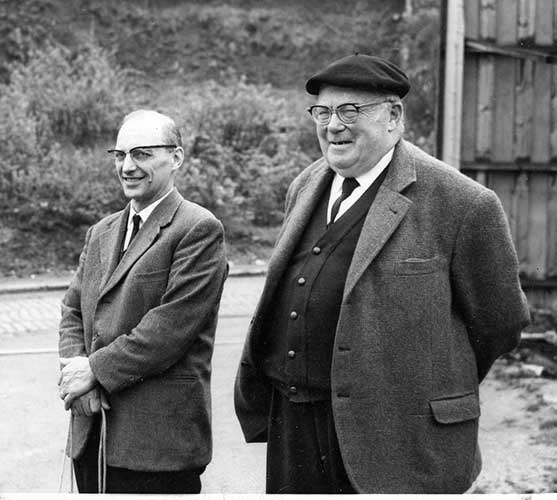
Justin Chastel on the left, Felix Verbanck on the Right, 1965