
DONAR
Jim Engel, 1985
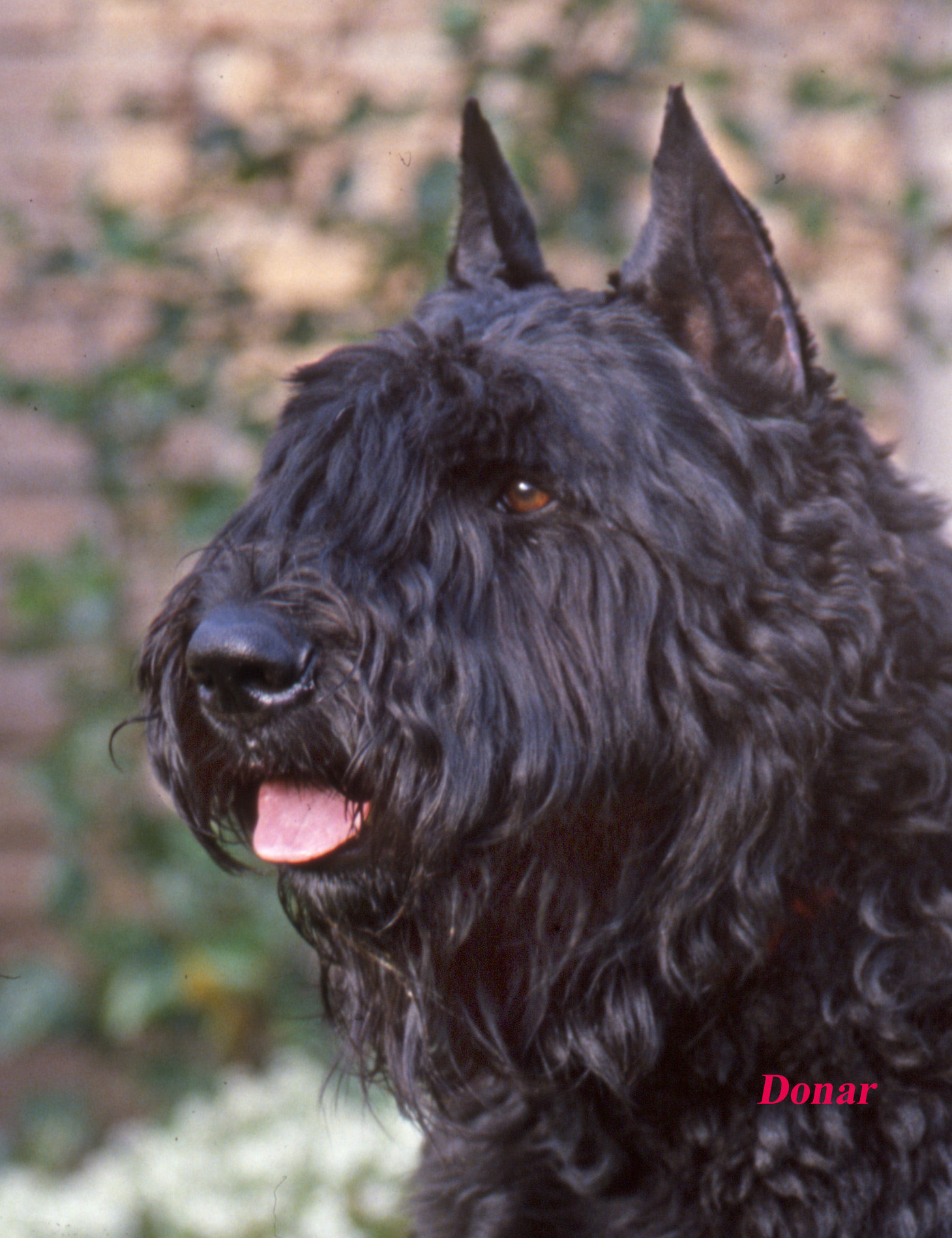
Clk to enlarge
It has always seemed to me that the passing of a dog should be a private matter, that those whose lives have been effected are best left to cope with grief according to their own means. But on rare occasions a dog whose passing cannot go without comment comes into our lives, such has been the breadth and depth of his impact.
Ria Klep's Donar is dead, and the passing of this great dog leaves a void in the Bouvier world, and the hearts of those fortunate enough to have known him, that will not easily be filled. There may have been even better working Bouviers, for a couple of German dogs have very impressive score books and a number of dogs have demonstrated excellence in the Dutch Police trials and the ring of Belgium and France. Ksar de la Thudinie was a working champion in France. But greatness is a matter of fate and timing as well as individual excellence, and this extraordinary pair came onto the Bouvier scene at a crucial juncture to remind much of Europe of what the Bouvier heritage is really all about.
In some ways this big black dog was not a likely candidate for greatness. He had a simple, one word name in a time of elaborate and pretentious kennel names. He was a dog of pure Dutch breeding in an era when many of the Dutch were abandoning a fifty year breeding tradition in a headlong rush to Belgian dogs. Many of his ancestors had great records in the Dutch Police trials at a time when fewer and fewer Bouviers were competing in that arena. He was, above all else, a great working dog when the eye of the fancy was being drawn increasingly to the show ring.
His pedigree is a litany of the Dutch heritage. It includes the great KNPV dogs such as Borissio, Dolfo and Nerodan. And the founding kennels, represented in names such as Bica v d Rozenheerd, Rato v d Ouden Dijk and Bianca v Baakenstein. Only time will tell if he marks the end of an era, if this heritage is to be truly abandoned by the Dutch people after fifty years of striving by countless Dutch breeders and trainers.
For Americans, this story began when Erik Houttuin, traveling in Europe early
in 1982, heard tales of a big black dog in the village of Ulvenhout, just outside
of the Dutch city of Breda and within a few miles of the Belgian boarder. This
dog called Donar had become both Schutzhund III and FH at the tender age of
eighteen months and shortly thereafter became the Bouvier Working Champion of
Holland.
Arriving at the home of the owners, Jos and Ria Klep, Erik found that
only Donar and the Klep's two daughters were home. Under the watchful eye of
Donar, he left a note saying that they must come to America. There was no doubt
much discussion of these strange Americans in the Klep household that evening.
Ria Klep was no novice trainer, for previously she had reached Schutzhund III with a dog called Wodan le Jardin Etoile at a time when Schutzhund was very new in the Netherlands. Wodan was apparently poisoned under mysterious circumstances, and for many months Ria spent weekends traveling to evaluate Bouvier litters, looking for her next dog. The rest is now Bouvier history.
In the end the Kleps accepted Erik's invitation and brought Donar to America, where he entered the working championships at Niagara-on-the-Lake in Ontario. There was never any question of who was star of this show, and Donar put on a working demonstration that opened the eyes of Canadians and Americans alike, for we had never seen anything like it. When the placements were announced and the trophies awarded, he responded to the applause by stretching out to a full alert posture and barking his recognition - the dog knew that he was a winner and his knowing it played a big part in making it happen.
Donar and Ria went on to compete in our national Schutzhund championships in Los Angeles, where Donar came in a strong third in spite of a heavy penalty for tracking "too fast." There was no doubting Donar's enthusiasm for tracking, for his style was akin to a freight train until he came to a corner, where he seemed to suspend the laws of physics for a moment as he changed direction, full speed.
For me watching this working team was always an inspiring experience. The concentration and total dedication to excellence set an example for all of us - in the days before the trial no detail was too small for consideration, no potential distraction to insignificant to be prepared for. As those who saw him on his American tour or in Europe can attest, Donar was spectacular in the protection work.
But in many ways his obedience was the most striking, for this big dog executed with total enthusiasm at flank speed - when he went over the 'A' frame after the dumbbell, he hit it on the way back almost before the echo of his first strike had died away. This of course takes full advantage of the fact that the dog and his handler largely set the pace in the Schutzhund trial and the quick team gives the judge just that much less opportunity to observe and record point deductions.
Donar's tour of America was a huge success, for this big black dog is still well remembered in Bouvier and Schutzhund circles alike, such was his presence on the working field.
Donar has not gone without notice by breeders in America, for his progeny are even now being bred in a number of our most influential kennels. There is a son at Belco Farm near Philadelphia, home of the "du Clos des Cerberes" Bouviers, who is a primary stud dog as well as a Champion. A son and two daughters reside at Erik Houttuin's Flandersfield Kennels in Missouri. My personal dog is a son of Donar called Centauri's Gambit, who is a Champion as well as Schutzhund III, and my wife Kathy primarily trains his daughter called Hantal, who is Schutzhund I. There are others in California and elsewhere. Over the coming years Donar seems destined to emerge as the Dutch dog who has had the most influence on the breeding of the Bouvier des Flandres in America. He may be gone, but he is not forgotten.
The passing of Donar has been an event of immense sadness for me, for when this dog came into my life that fateful October day in 1982 I came to understand fully what the Bouvier was meant to be, and to know that our goal of breeding the Bouvier as a true working dog is within reach. Donar was for me always bigger than life, almost too good to be true, a dog whose like we may never see again. In my mind he will always be the standard by which Bouviers are measured.
The greatest loss is of course in the home of Jos and Ria Klep, in many ways dominated by the presence of this great dog these past years. But in a larger sense a beacon representing every Dutch breeder over the past half century has been extinguished, for Donar was the ultimate product of that heritage at a time when its continuation is in serious jeopardy.